Primitives
Abstract
Meshes.Primitive — Type
Primitive{M,CRS}We say that a geometry is a primitive when it can be expressed as a single entity with no parts (a.k.a. atomic). For example, a sphere is a primitive described in terms of a mathematical expression involving a metric and a radius. See https://en.wikipedia.org/wiki/Geometric_primitive.
Concrete
Point
Meshes.Point — Type
Point(x, [y, z])
Point((x, [y, z]))
A point with Cartesian coordinates in length units (default to meters). The coordinates y and z are optional for 2D and 3D points, respectively.
Point(CRS(...))A point with coordinates in a specified coordinate reference system (CRS). Please check CoordRefSystems.jl for available coordinate reference systems.
Point{M}(CRS(...))Optionally, specify the manifold M of the point. The default manifold is 𝔼{dim} (Euclidean space). It can also be 🌐 in which case the point is interpreted as a point on the surface of the Earth (or any other spheroid).
Examples
# points in 2D Euclidean space
Point(1.0, 2.0) # meter units by default
Point(1.0m, 2.0m) # double precision as expected
Point(1f0m, 2f0m) # single precision as expected
Point(1m, 2m) # integer is converted to float by design

# points in 3D Euclidean space
Point(1km, 2km, 3km) # specify kilometer units
Point(1m, 2ft, 3in) # mixed units are promoted

# points on the surface of the Earth
Point(LatLon(0.0, 0.0)) # degree units by default
Point(LatLon(0.0°, 0.0°)) # specify units explicitly

# specify manifold explicitly
Point{🌐}(convert(Cartesian, LatLon(0.0, 0.0)))
Notes
Integer coordinates are not supported because most geometric processing algorithms assume a continuous space. The conversion to float avoids InexactError and other unexpected results.
rand(Point, 100) |> viz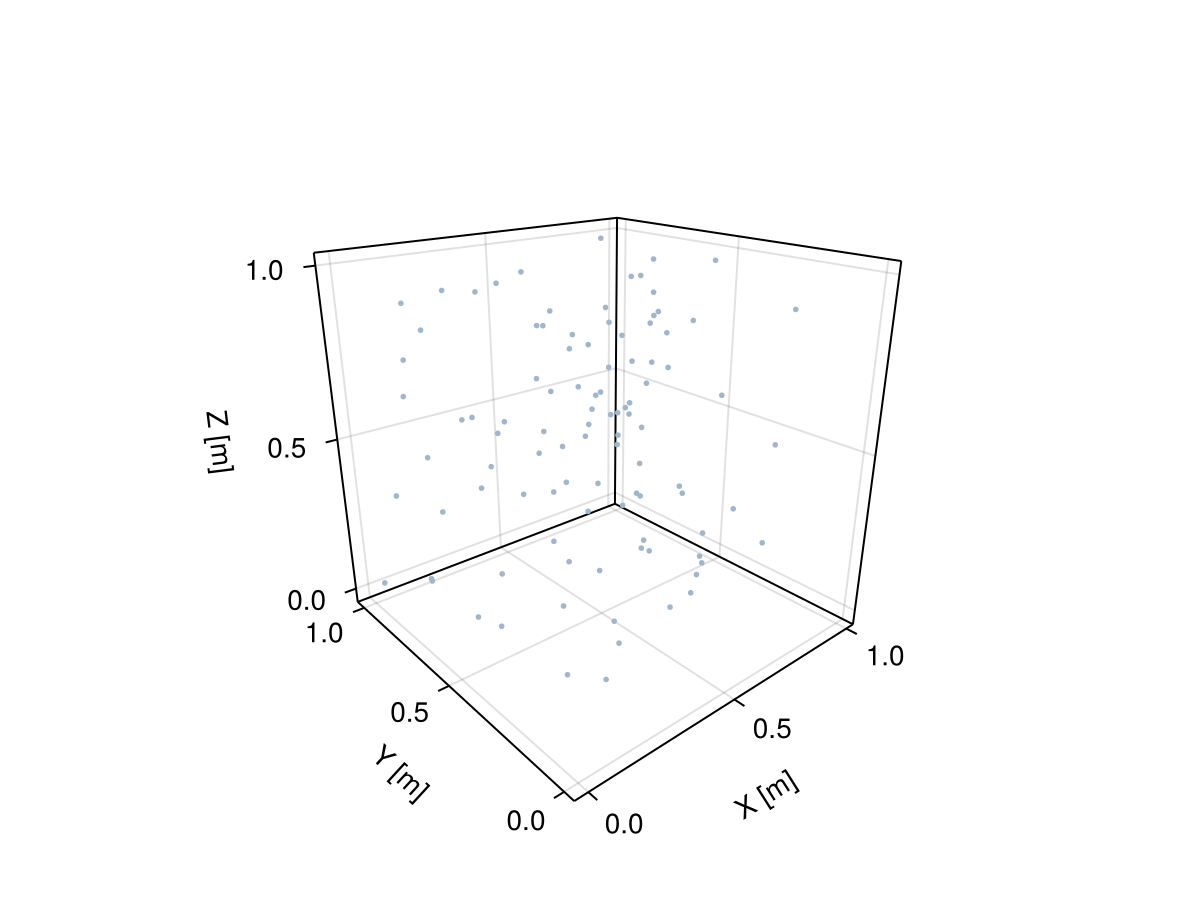
Ray
Meshes.Ray — Type
Ray(p, v)A ray originating at point p, pointed in direction v. It can be called as r(t) with t > 0 to cast it at p + t * v.
Ray((1, 2, 3), (1, 0, 1)) |> viz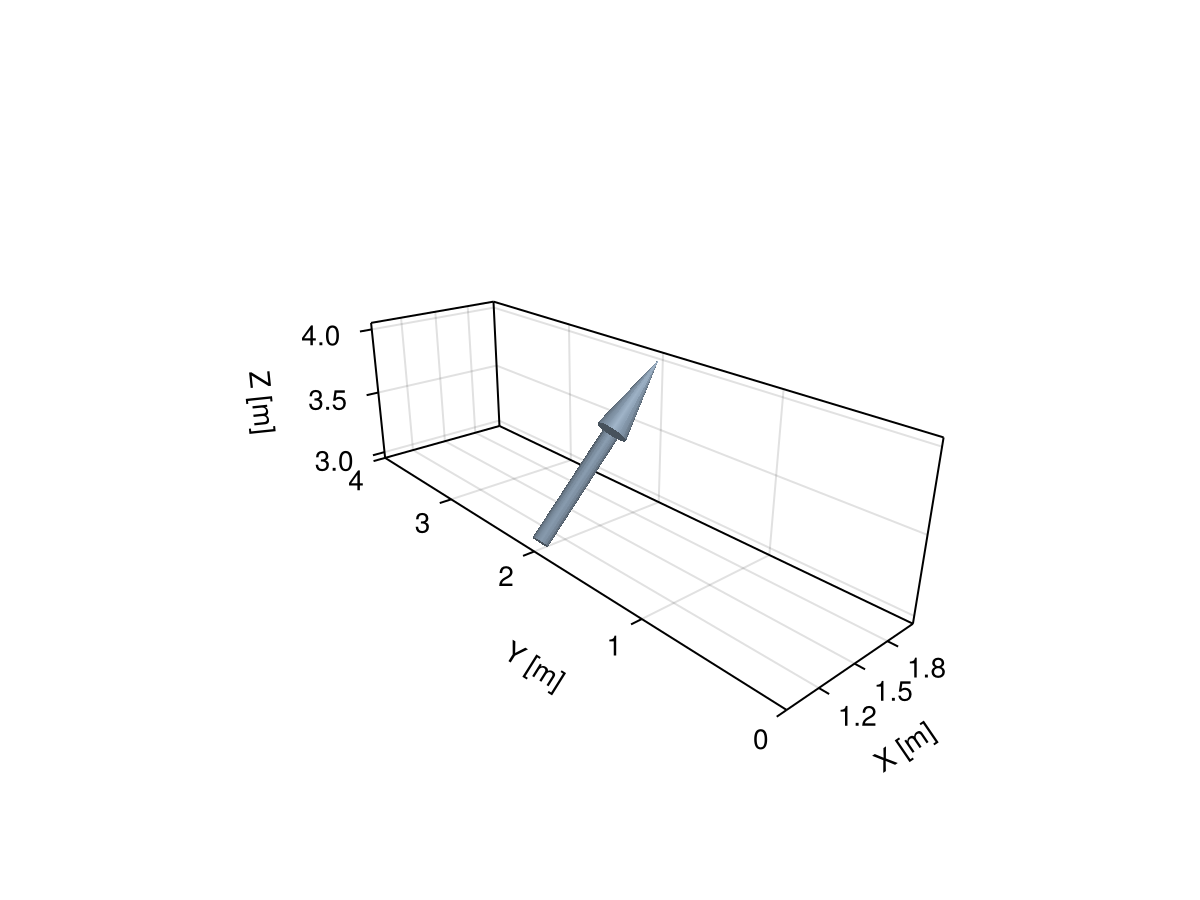
Line
Meshes.Line — Type
Line((1, 2), (3, 5)) |> viz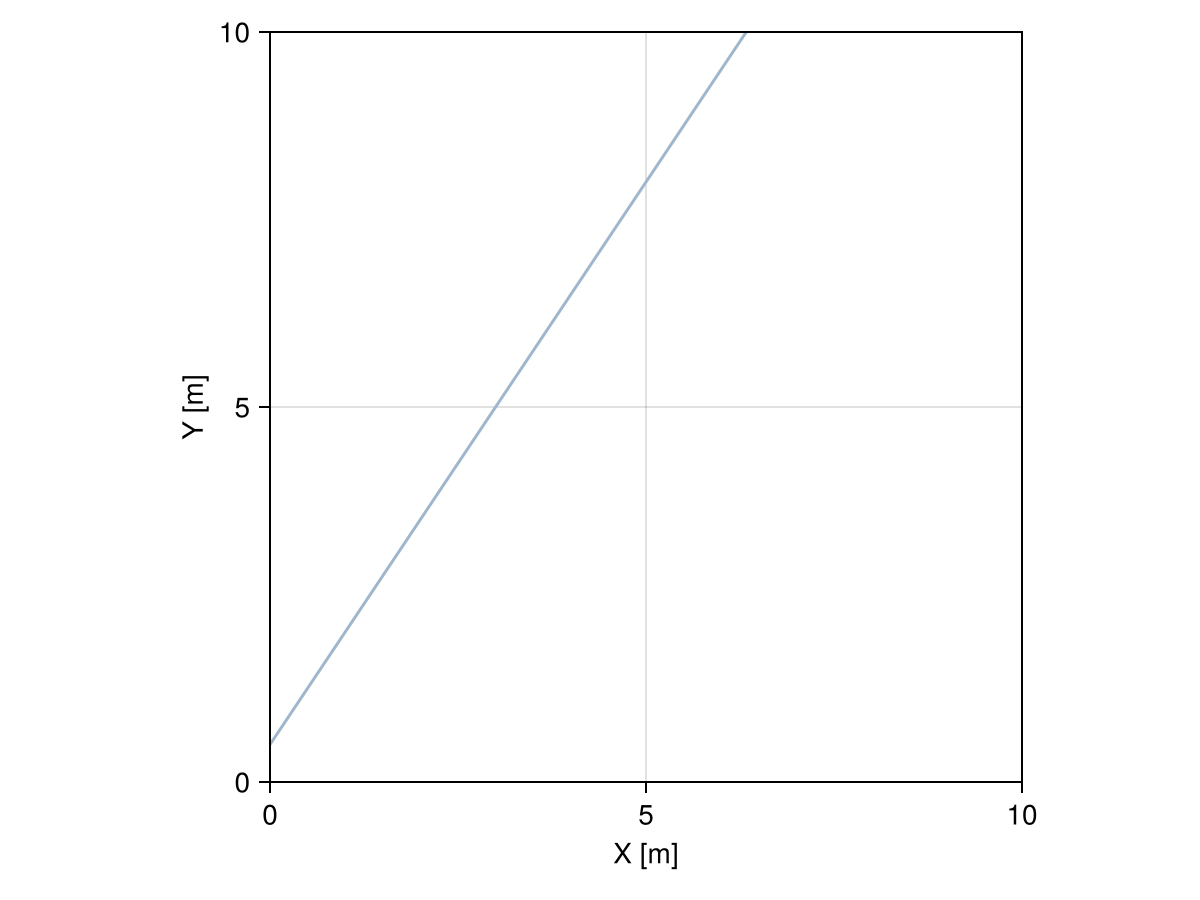
BezierCurve
Meshes.BezierCurve — Type
BezierCurve(points)A recursive Bézier curve with control points points. See https://en.wikipedia.org/wiki/Bézier_curve.
A point on the Bézier curve b can be evaluated by calling b(t) with t between 0 and 1. The evaluation method defaults to DeCasteljau's algorithm for accurate evaluation. Horner's method, faster with a large number of points but less precise, can be used via b(t, Horner()).
Examples
BezierCurve([(0.,0.),(1.,-1.)])BezierCurve((0, 0), (1, 0), (1, 1)) |> viz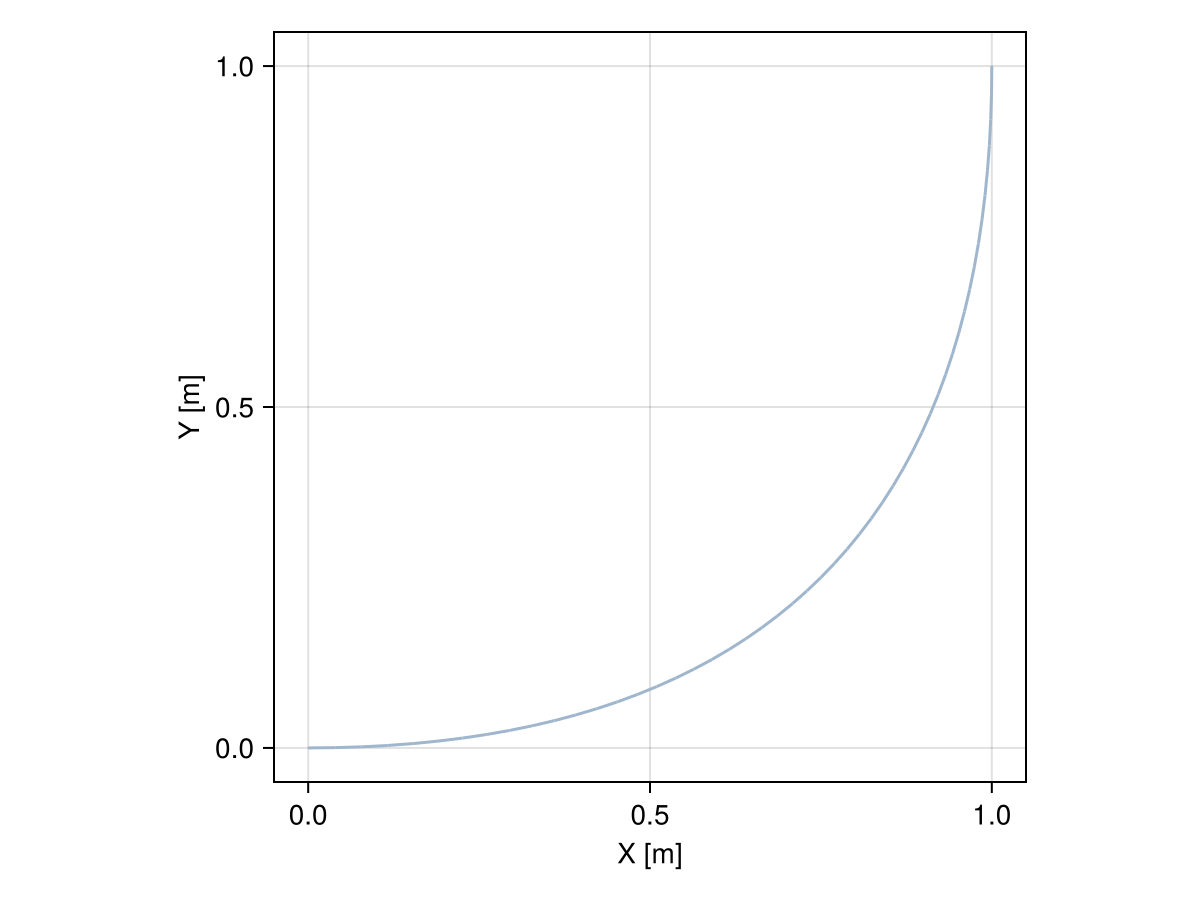
ParametrizedCurve
Meshes.ParametrizedCurve — Type
ParametrizedCurve(fun, range = (0.0, 1.0))A parametrized curve is a curve defined by a function fun that maps a (unitless) parameter t in the given range to a Point in space.
Examples
ParametrizedCurve(t -> Point(cos(t), sin(t)), (0, 2π))ParametrizedCurve(t -> Point(cos(t), sin(t), 0.2t), (0, 4π)) |> viz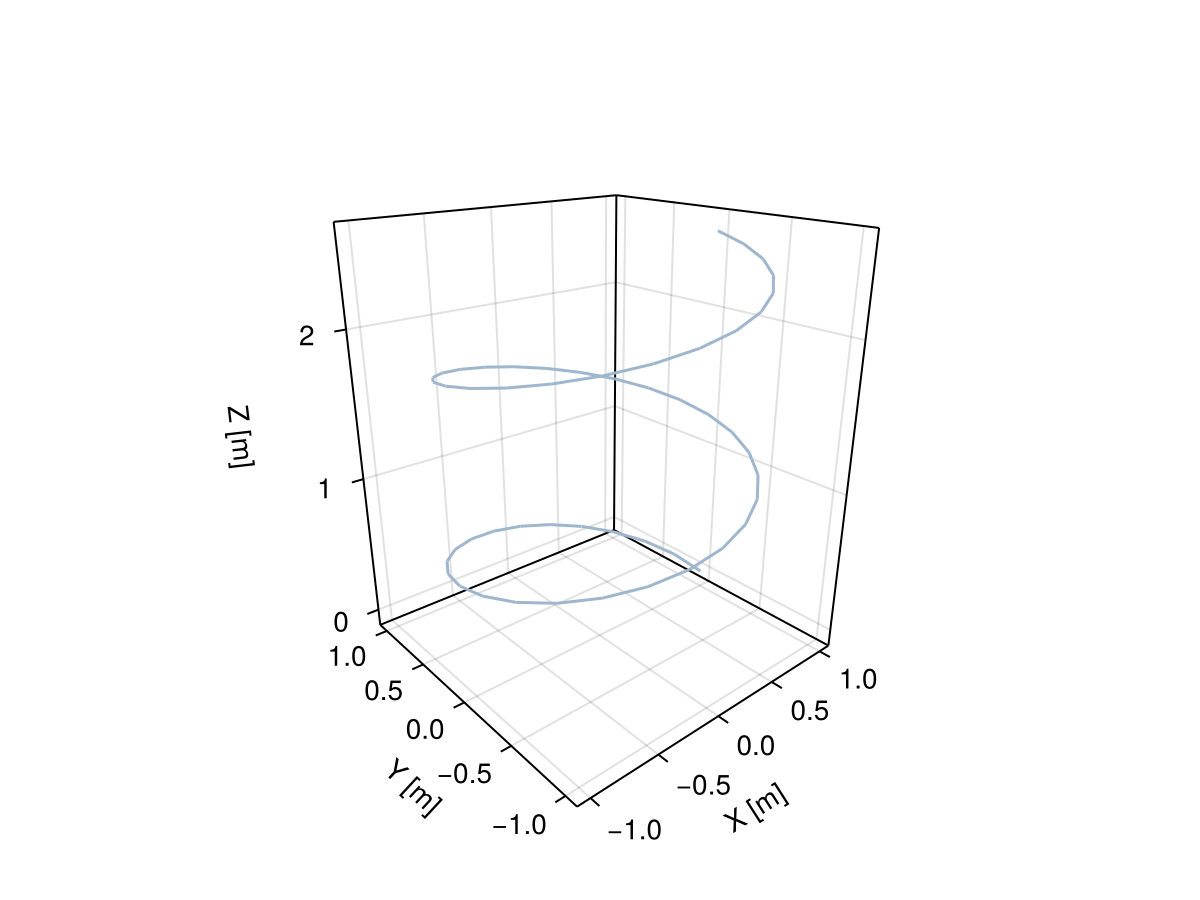
Plane
Meshes.Plane — Type
Plane(p, u, v)A plane embedded in R³ passing through point p, defined by non-parallel vectors u and v.
Plane(p, n)Alternatively specify point p and a given normal vector n to the plane.
Box
Meshes.Box — Type
Box(min, max)A (geodesic) box with min and max points on a given manifold.
Examples
Construct a 3D box using points with Cartesian coordinates:
Box((0, 0, 0), (1, 1, 1))Likewise, construct a 2D box on the plane:
Box((0, 0), (1, 1))Construct a geodesic box on the ellipsoid:
Box(Point(LatLon(0, 0)), Point(LatLon(1, 1)))Box((0, 0, 0), (1, 1, 1)) |> viz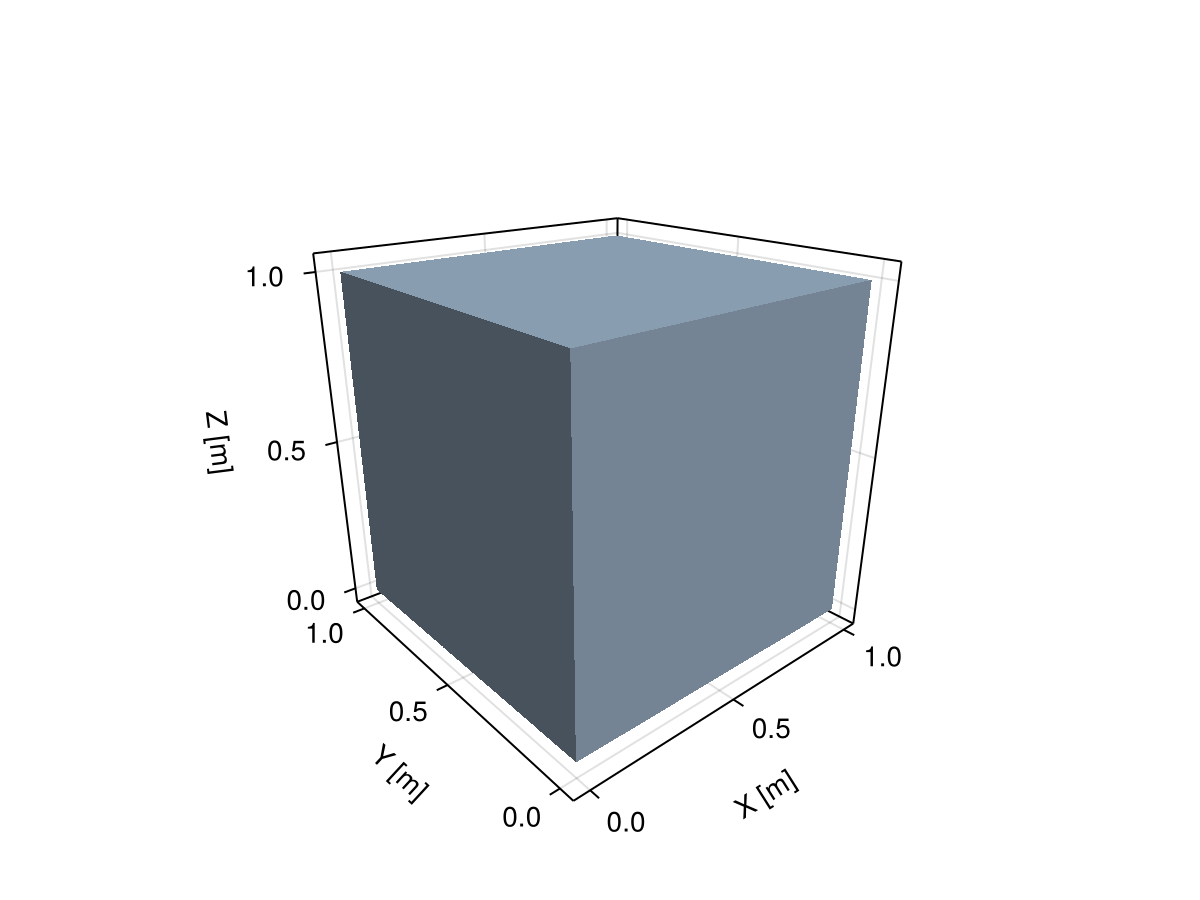
Ball/Sphere
Meshes.Ball — Type
Meshes.Sphere — Type
Ball((0, 0, 0), 1) |> viz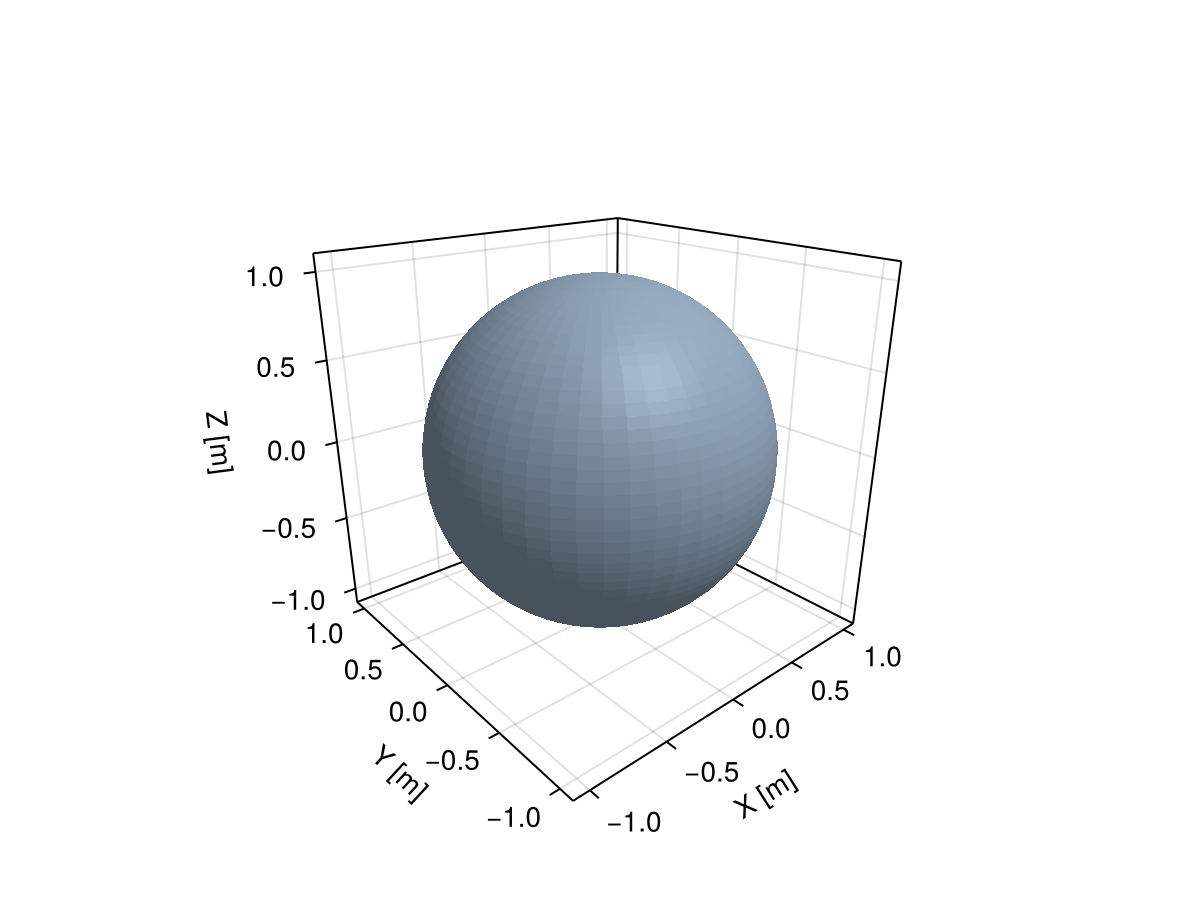
Ellipsoid
Meshes.Ellipsoid — Type
Ellipsoid(radii, center=(0, 0, 0), rotation=I)A 3D ellipsoid with given radii, center and rotation.
Ellipsoid((3, 2, 1)) |> viz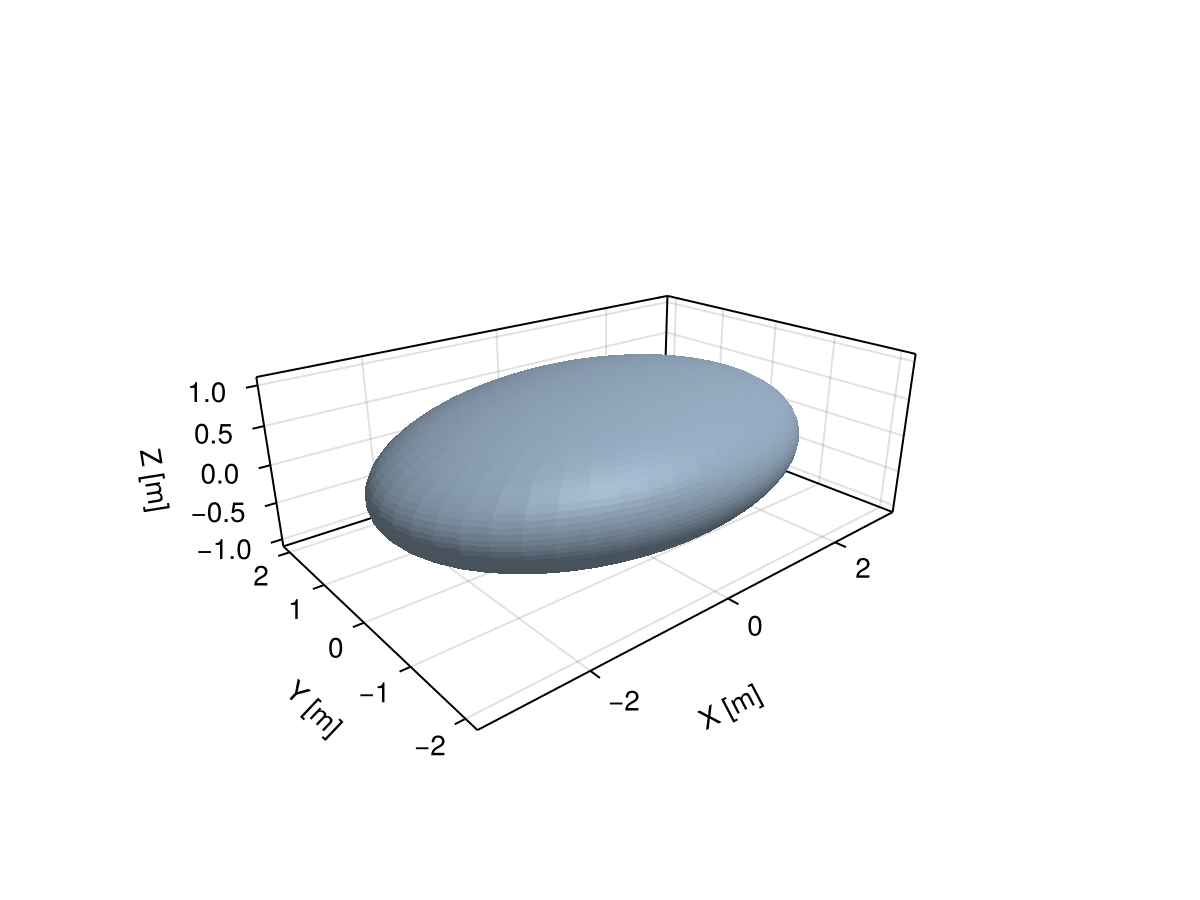
Disk/Circle
Meshes.Disk — Type
Disk(plane, radius)A disk embedded in 3-dimensional space on a given plane with given radius.
See also Circle.
Meshes.Circle — Type
Circle(plane, radius)A circle embedded in 3-dimensional space on a given plane with given radius.
See also Disk.
Disk(Plane((0, 0, 0), (1, 0, 1)), 1) |> viz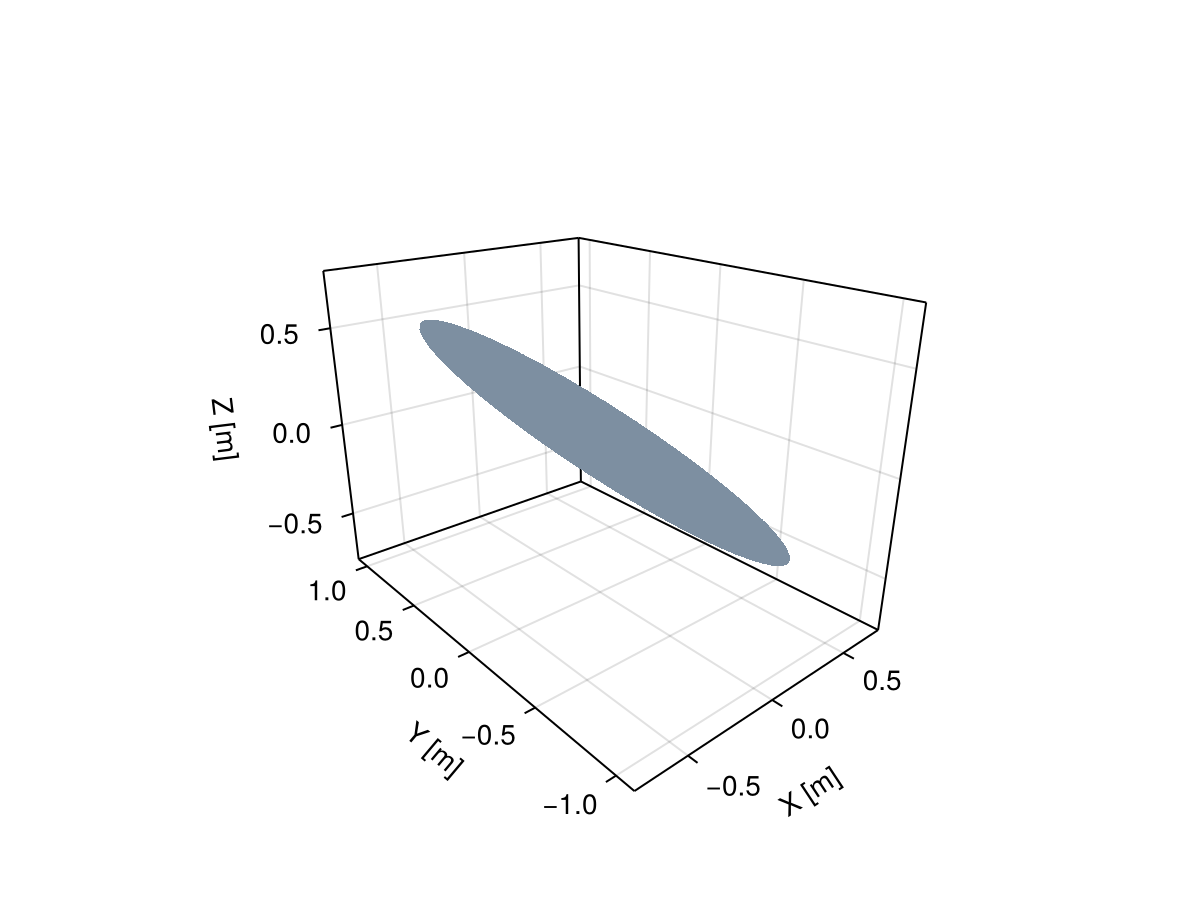
Cylinder/CylinderSurface
Meshes.Cylinder — Type
Cylinder(bottom, top, radius)A solid circular cylinder embedded in R³ with given radius, delimited by bottom and top planes.
Cylinder(start, finish, radius)Alternatively, construct a right circular cylinder with given radius along the segment with start and finish end points.
Cylinder(start, finish)Or construct a right circular cylinder with unit radius along the segment with start and finish end points.
Cylinder(radius)Finally, construct a right vertical circular cylinder with given radius.
See https://en.wikipedia.org/wiki/Cylinder.
See also CylinderSurface.
Meshes.CylinderSurface — Type
CylinderSurface(bottom, top, radius)A circular cylinder surface embedded in R³ with given radius, delimited by bottom and top planes.
CylinderSurface(start, finish, radius)Alternatively, construct a right circular cylinder surface with given radius along the segment with start and finish end points.
CylinderSurface(start, finish)Or construct a right circular cylinder surface with unit radius along the segment with start and finish end points.
CylinderSurface(radius)Finally, construct a right vertical circular cylinder surface with given radius.
See https://en.wikipedia.org/wiki/Cylinder.
See also Cylinder.
Cylinder(1) |> viz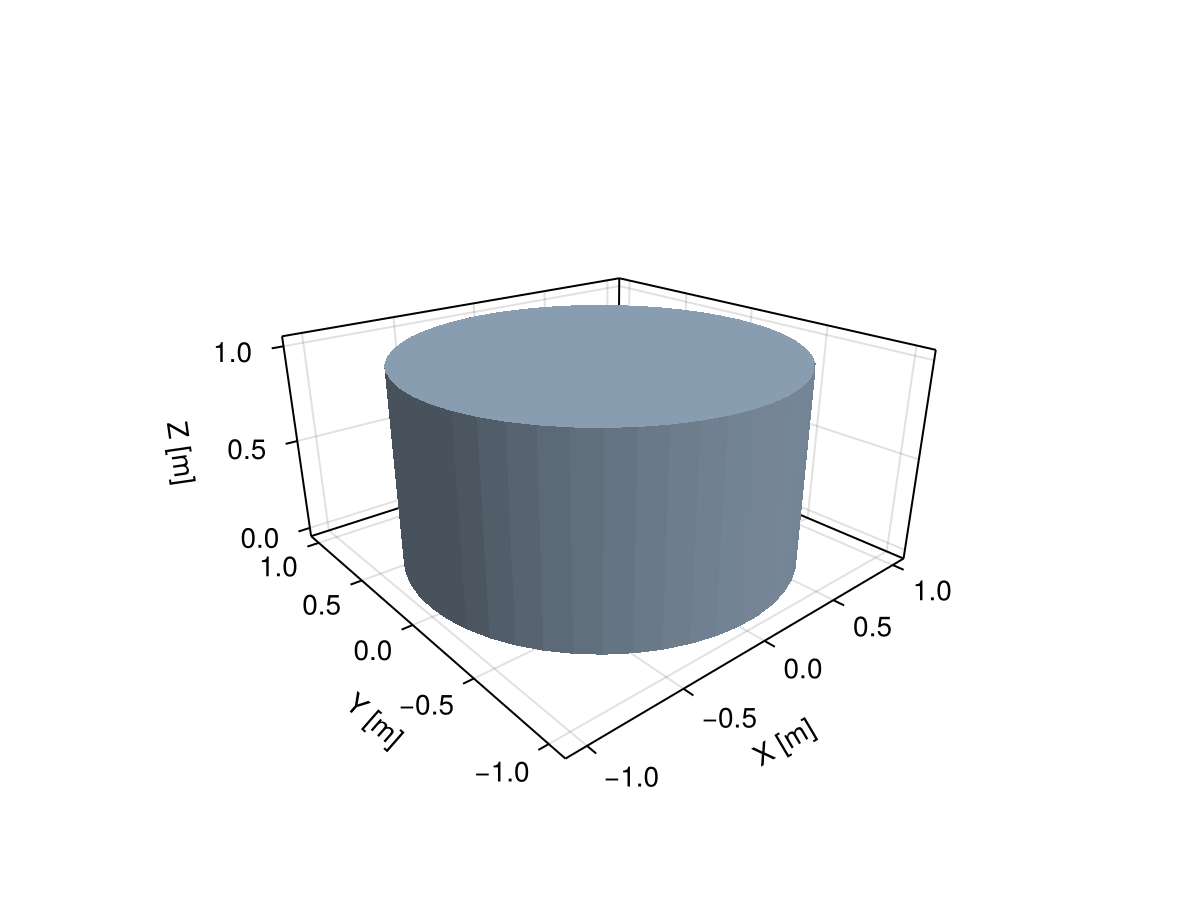
Cone/ConeSurface
Meshes.Cone — Type
Cone(base, apex)A cone with base disk and apex. See https://en.wikipedia.org/wiki/Cone.
See also ConeSurface.
Meshes.ConeSurface — Type
ConeSurface(base, apex)A cone surface with base disk and apex. See https://en.wikipedia.org/wiki/Cone.
See also Cone.
Cone(
  Disk(Plane((0, 0, 0), (0, 0, 1)), 1),
  (0, 0, 1)
) |> viz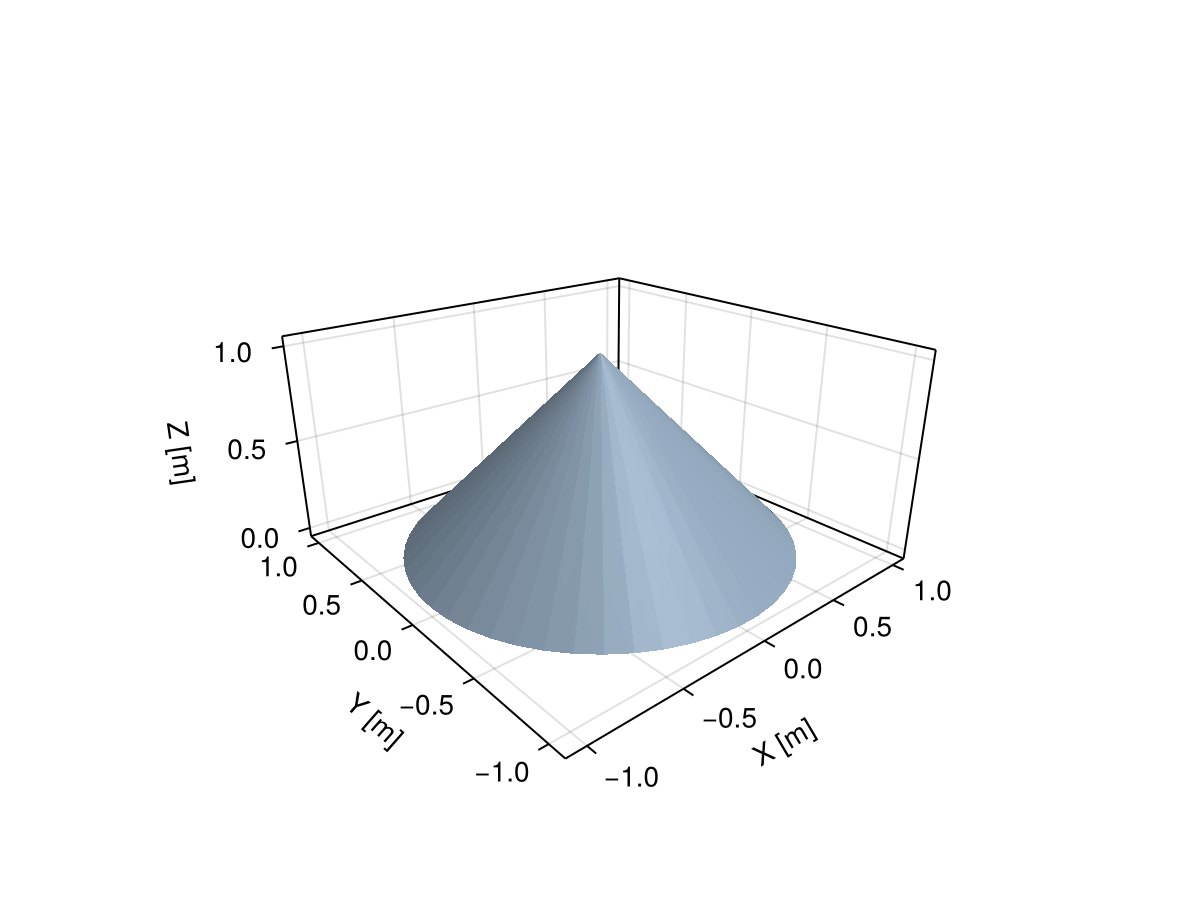
Frustum/FrustumSurface
Meshes.Frustum — Type
Frustum(bot, top)A frustum (truncated cone) with bot and top disks. See https://en.wikipedia.org/wiki/Frustum.
See also FrustumSurface.
Meshes.FrustumSurface — Type
FrustumSurface(bot, top)A frustum (truncated cone) surface with bot and top disks. See https://en.wikipedia.org/wiki/Frustum.
See also Frustum.
Frustum(
  Disk(Plane((0, 0, 0), (0, 0, 1)), 2),
  Disk(Plane((0, 0, 10), (0, 0, 1)), 1)
) |> viz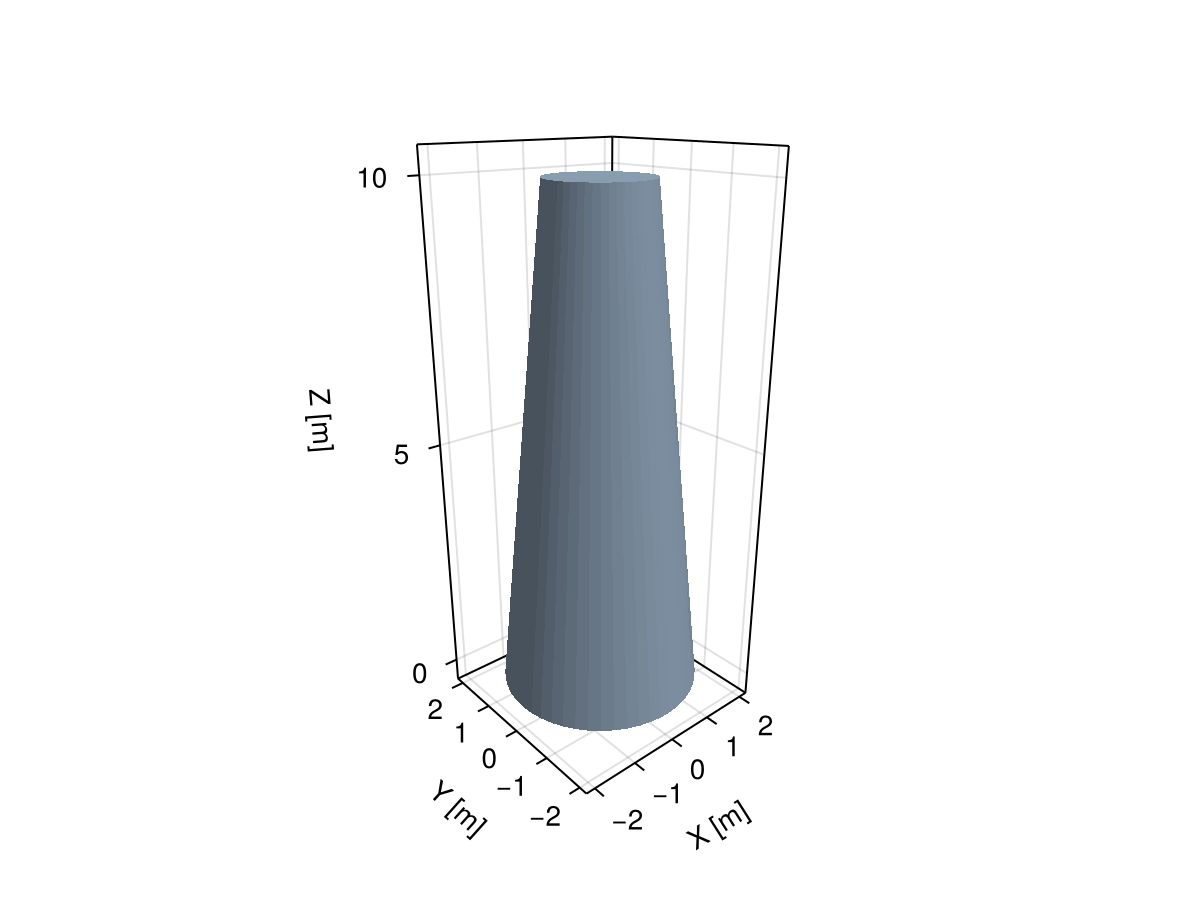
Paraboloid
Meshes.Paraboloid — Type
Paraboloid(apex, radius, focallength)A paraboloid embedded in R³ and extending up to a distance radius from its focal axis, which is aligned along the z direction and passes through apex (the apex of the paraboloid). The equation of the paraboloid is the following:
\[f(x, y) = \frac{(x - x_0)^2 + (y - y_0)^2}{4f} + z_0\qquad\text{for } (x - x_0)^2 + (y - y_0)^2 < r^2,\]
where $(x_0, y_0, z_0)$ is the apex of the parabola, $f$ is the focal length, and $r$ is the clip radius.
Paraboloid(apex, radius)This creates a paraboloid surface with focal length equal to 1.
Paraboloid(apex)This creates a paraboloid surface with focal length equal to 1 and a rim with unit radius.
Paraboloid()Same as above, but here the apex is at (0, 0, 0).
Paraboloid((0, 0, 0), 1, 0.25) |> viz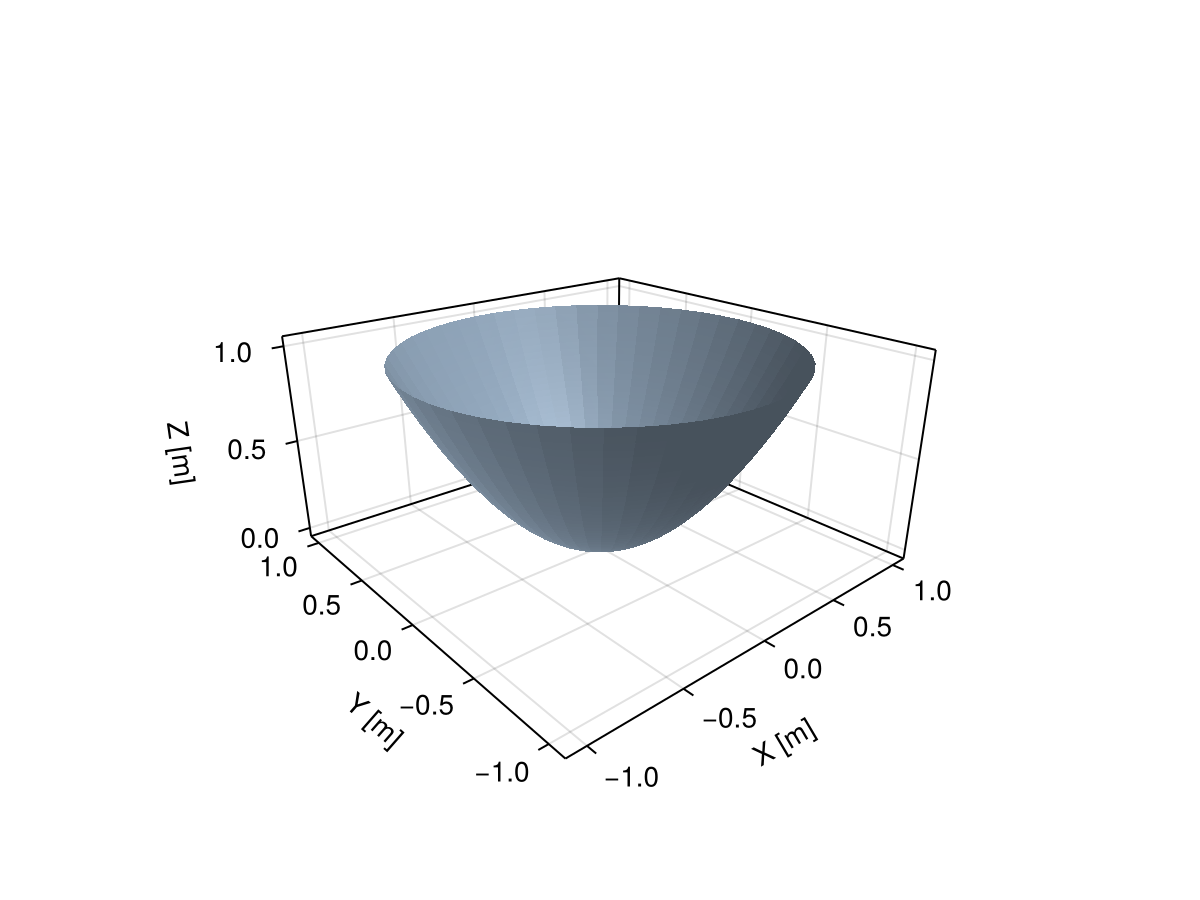
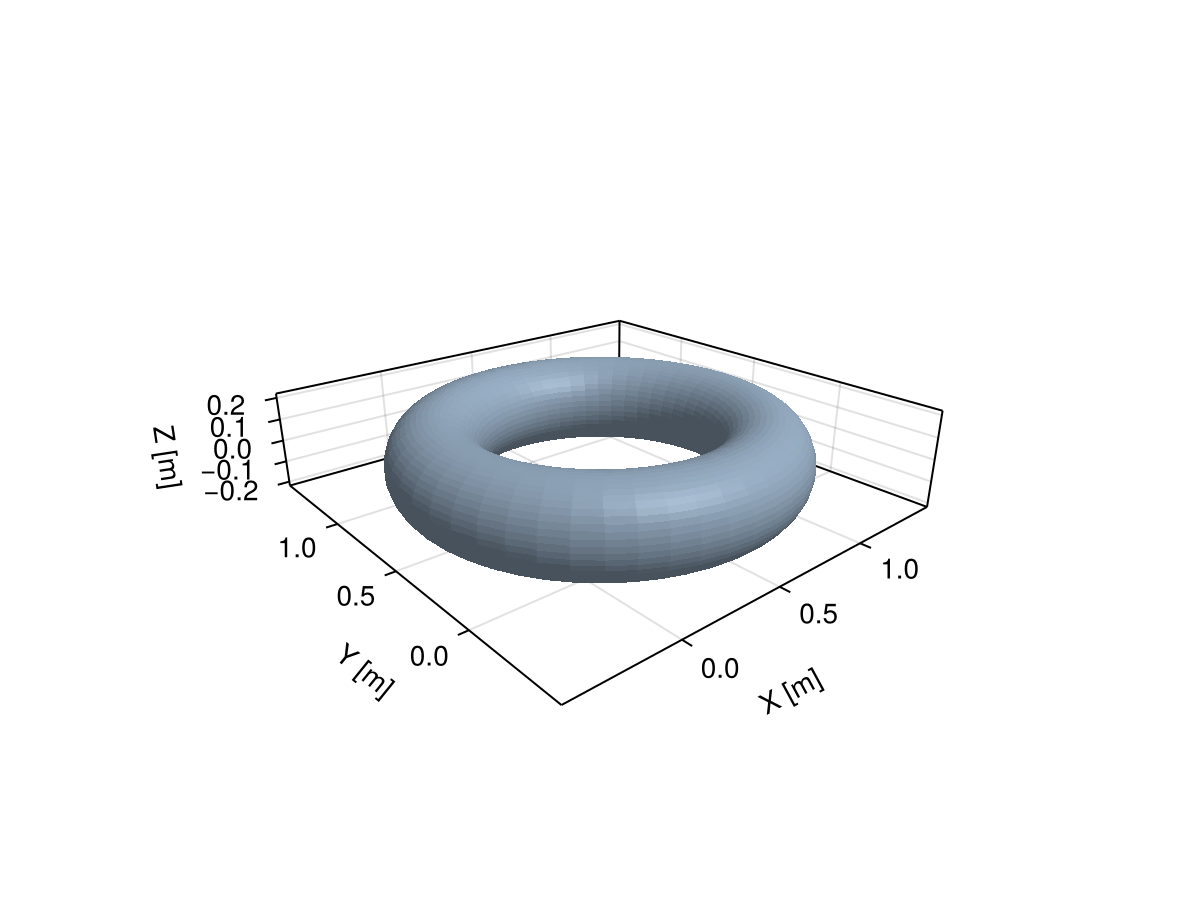
Torus
Meshes.Torus — Type
Torus(center, direction, major, minor)A torus centered at center with axis of revolution directed by direction and with radii major and minor.
Torus((0, 0, 0), (1, 0, 0), (0, 1, 0), 0.2) |> viz