Triangulating Convex Polygons
In this tutorial, we show how we can triangulate convex polygons. The function triangulate_convex is used for this. Let us start with a simple example.
using DelaunayTriangulation
using CairoMakie

points = [
    (10.0, 12.0), (7.0, 11.0), (8.0, 6.0),
    (10.0, 3.0), (14.0, 5.0), (15.0, 10.0),
    (13.0, 12.0),
]
S = 1:7
tri = triangulate_convex(points, 1:7)
Delaunay Triangulation.
Number of vertices: 7
Number of triangles: 5
Number of edges: 11
Has boundary nodes: false
Has ghost triangles: true
Curve-bounded: false
Weighted: false
Constrained: falsefig, ax, sc = triplot(tri)
fig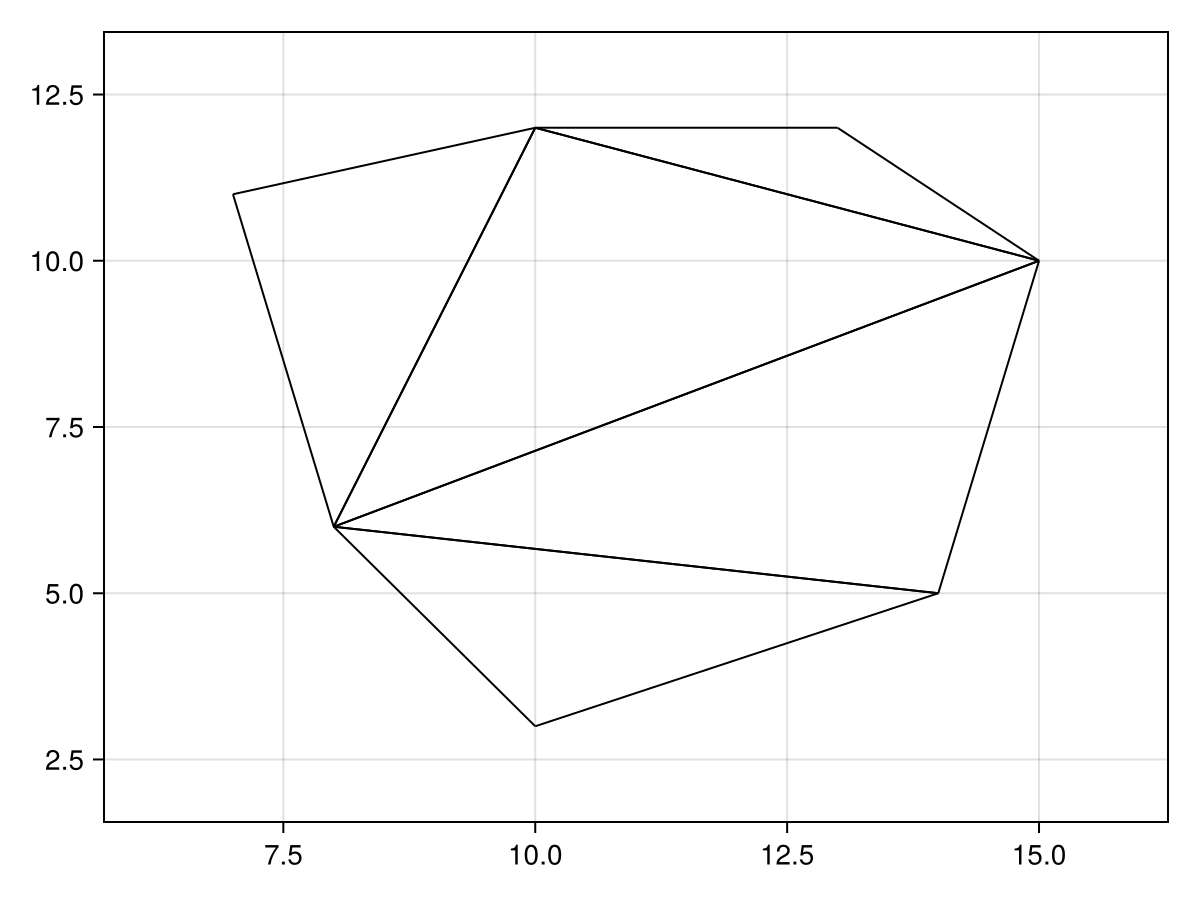
This tri is our triangulation of the convex polygon. The first input is the set of points, and S defines the vertices to take from these points and their order, which must be provided in a counter-clockwise order. Note that points does not have to contain only the points of the polygon, since S will be used to define the points needed.
Let us give a larger example. For simplicity, we triangulate a a discretised circle.
θ = LinRange(0, 2π, 5000) |> collect
pop!(θ)
x = cos.(θ)
y = sin.(θ)
points = tuple.(x, y)
S = 1:4999 # can also be [1:4999; 1], if you want the array to be circular
tri = triangulate_convex(points, S)Delaunay Triangulation.
Number of vertices: 4999
Number of triangles: 4997
Number of edges: 9995
Has boundary nodes: false
Has ghost triangles: true
Curve-bounded: false
Weighted: false
Constrained: falsefig, ax, sc = triplot(tri)
fig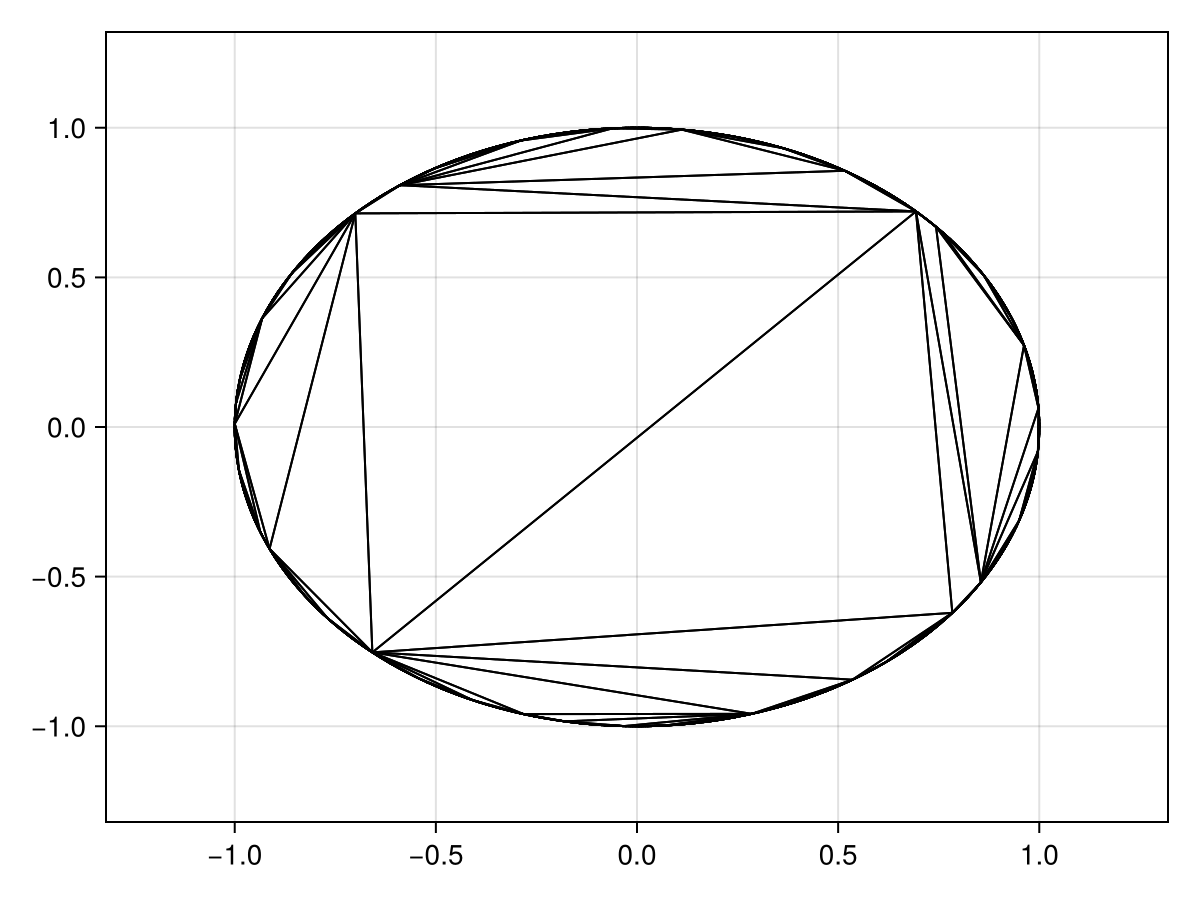
Here is a comparison of the time it takes to triangulate this using triangulate_convex or triangulate.
using BenchmarkTools
@benchmark triangulate_convex($points, $S)BenchmarkTools.Trial: 144 samples with 1 evaluation per sample.
Range (min … max): 27.835 ms … 386.156 ms ┊ GC (min … max): 0.00% … 91.71%
Time (median): 31.133 ms ┊ GC (median): 0.00%
Time (mean ± σ): 34.922 ms ± 29.951 ms ┊ GC (mean ± σ): 11.41% ± 11.55%
▁▇█▆▁
▄█████▃▅▃▃▂▃▃▂▃▂▁▁▁▂▁▁▂▂▁▁▂▁▁▁▁▁▁▁▁▁▁▁▁▁▁▁▁▁▁▁▁▁▁▁▁▁▁▁▁▁▁▁▁▂ ▂
27.8 ms Histogram: frequency by time 78.8 ms <
Memory estimate: 16.00 MiB, allocs estimate: 59806.@benchmark triangulate($points)BenchmarkTools.Trial: 97 samples with 1 evaluation per sample.
Range (min … max): 43.926 ms … 405.289 ms ┊ GC (min … max): 0.00% … 87.93%
Time (median): 47.039 ms ┊ GC (median): 0.00%
Time (mean ± σ): 51.927 ms ± 36.719 ms ┊ GC (mean ± σ): 9.35% ± 10.72%
▁▂▃█▃
█████▆▅▃▄▃▃▁▃▃▃▃▁▁▁▁▁▁▃▃▁▁▁▁▁▁▁▁▁▁▁▁▁▁▁▁▁▁▁▁▁▁▁▁▁▁▁▁▁▁▁▁▁▁▁▃ ▁
43.9 ms Histogram: frequency by time 94 ms <
Memory estimate: 16.87 MiB, allocs estimate: 44529.For the smaller example that we started with above, triangulate_convex is also faster, although not by much (≈15.10 μs versus ≈10.7 μs).
Just the code
An uncommented version of this example is given below. You can view the source code for this file here.
using DelaunayTriangulation
using CairoMakie
points = [
(10.0, 12.0), (7.0, 11.0), (8.0, 6.0),
(10.0, 3.0), (14.0, 5.0), (15.0, 10.0),
(13.0, 12.0),
]
S = 1:7
tri = triangulate_convex(points, 1:7)
fig, ax, sc = triplot(tri)
fig
θ = LinRange(0, 2π, 5000) |> collect
pop!(θ)
x = cos.(θ)
y = sin.(θ)
points = tuple.(x, y)
S = 1:4999 # can also be [1:4999; 1], if you want the array to be circular
tri = triangulate_convex(points, S)
fig, ax, sc = triplot(tri)
fig
using BenchmarkTools
@benchmark triangulate_convex($points, $S)
@benchmark triangulate($points)This page was generated using Literate.jl.